Bridging the Gap: Environmental Laws and Their Implementation in Pakistan

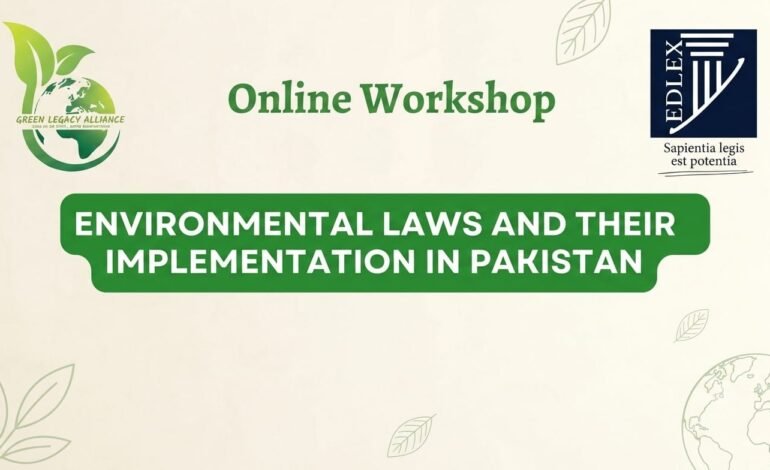
As Pakistan continues to grapple with escalating ecological pressures—ranging from suffocating urban smog to critical water scarcity—the dialogue around environmental jurisprudence has never been more urgent. Recognizing this pressing need, the Green Legacy Alliance recently convened an insightful digital workshop titled “Environmental Laws and Their Implementation in Pakistan.”
Moderated by Mr. Najid Hakim, Director of Legal Affairs at the Green Legacy Alliance, the online forum drew an engaged audience of climate enthusiasts, university students, environmental professionals, and concerned citizens from across Pakistan and beyond borders. The central focus of the session was examining why sound environmental legislation often faces hurdles during on-ground execution, and how civil society can bridge that divide.
Decoding Pakistan’s Legal Framework and Enforcement Mechanisms
The virtual floor was graced by Mr. Ahmad Rafay Alam, one of Pakistan’s most prominent environmental lawyers, who delivered a comprehensive breakdown of the country’s legal architecture, detailing how regulatory institutions have evolved and the systemic bottlenecks that hinder effective execution. Rather than viewing laws as static rules, the discussion illuminated the practical instruments available to regulatory bodies, emphasizing vital legal mechanisms such as Environmental Quality Standards, pollution control measures, Initial Environmental Examinations (IEE), and comprehensive Environmental Impact Assessments (EIA).
Delving deeper into executive enforcement, Mr. Alam explained how Section 16 empowers the Environmental Protection Agency to issue Environmental Protection Orders for immediate mitigation, technical equipment updates, and active site restoration where adverse environmental impacts occur. He further highlighted that non-compliance with these directives authorizes the agency to execute mandatory remedial actions directly at the offender’s expense.
Expanding on the financial consequences of regulatory breaches, the session addressed Section 17 penalties, which impose severe liability including major fines of up to five million rupees with daily recurring penalties for serious contraventions like industrial emissions or unauthorized EIAs, alongside substantial fines for standard infractions such as motor vehicle and hazardous substance violations.
“Laws are only as powerful as our collective resolve to enforce them and our willingness to participate in environmental stewardship.”
As the session drew to a close, Mr. Ashar Ali, Co-Founder of the Green Legacy Alliance, addressed the attendees and expressed deep appreciation for their enthusiastic participation while commending Mr. Ahmad Rafay Alam for delivering an exceptionally thorough and insightful breakdown of complex legal realities. The workshop concluded with a renewed, shared commitment between organizers, speakers, and participants to continuously foster environmental literacy, mobilize youth alliances across Pakistan, and drive actionable initiatives toward a healthier, greener, and more sustainable future.
The workshop concluded with a renewed, shared commitment between organizers, speakers, and participants: to continuously foster environmental literacy, mobilize youth alliances across Pakistan, and drive actionable initiatives toward a healthier, greener, and more sustainable future.
Why Environmental Dialogues Matter for Pakistan’s Future
Open educational discussions and legal literacy sessions are vital in a developing nation like Pakistan, where policy frameworks often exist on paper but struggle with ground-level enforcement due to institutional capacity gaps and low public awareness. By demystifying complex environmental laws, such initiatives empower youth and local communities to actively demand corporate accountability, champion ecological preservation, and participate meaningfully in building a climate-resilient future.
About Author:
Afshan Younus is an MPhil graduate in Media and Communication Studies with professional broadcast journalism experience in major news channels, and is currently a digital content creator focusing on climate and sustainability.